
Top Programming Languages for 2026 and Beyond
As we look ahead to 2026, the technology landscape is settling into a fascinating new rhythm. The “move fast and break things” era is maturing into a focus on stability, performance, and AI integration.
For learners and professionals looking to pivot, this shift is crucial. It means the most valuable skills are those that power the core pillars of this new digital world: the rapid innovation of the “Application Layer,” the raw power of the “Systems Layer,” and the unwavering reliability of the “Enterprise Standard.”
If you want to build a future-proof career in tech, your list is spot-on. Here is a detailed breakdown of the top programming languages that will define 2026, including why they matter and their real-world applications.
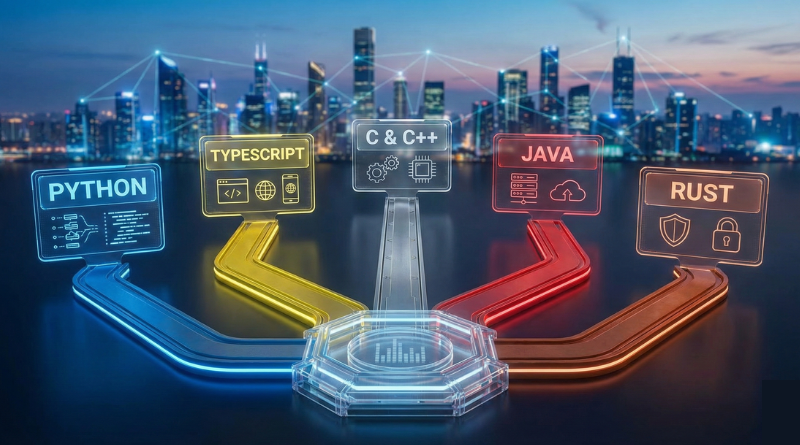
Top 5 Programming Languages to Learn in 2025
Python: The King of Data & AI
The Vibe: The “Glue” of the Digital World
In 2026, Python isn’t just a language; it is an ecosystem necessity. While it’s not the fastest language for raw execution speed, it is hands-down the fastest for development speed. Its simplicity makes it the primary interface for the entire field of Artificial Intelligence.
Even if the heavy lifting is being done by C++ underneath, you will almost certainly control and interact with it using Python.
Why It Matters in 2026:
- AI & Machine Learning Dominance: It is the default language for training and deploying models (from Large Language Models to Computer Vision) using essential libraries like PyTorch and TensorFlow.
- Data Engineering: It’s the go-to tool for building pipelines that move, process, and clean massive amounts of data.
- Scripting & Automation: Python excels at “gluing” different software components together to automate boring, repetitive tasks, making it indispensable for DevOps and system administration.
Real-World Use Case: Imagine a Video Recommendation Engine (like the one on Netflix or YouTube).
- The “brain” that decides which video shows up next is written in Python.
- It takes your viewing history, processes the data using the Pandas library, and then runs it through a complex machine learning model built with PyTorch to predict what you’ll click on next.
Recommended Course: The Complete Python Bootcamp From Zero to Hero in Python
TypeScript: The Standard for Modern Web
The Vibe: JavaScript with Superpowers
The days of “move fast and break things” with plain, error-prone JavaScript are fading in professional settings. By 2026, TypeScript has solidified its position as the industry standard for web development.
It adds “types” to JavaScript (e.g., ensuring a variable meant for a number is actually a number), which prevents massive headaches and bugs when applications scale up to thousands of files and dozens of developers.
Why It Matters in 2026:
- Scalable Frontend Development: It’s the preferred choice for building complex, interactive user interfaces (UIs) with popular frameworks like React, Next.js, and Angular.
- Full-Stack Capabilities: You can write both the frontend (code in the browser) and backend (code on the server) in a single language, sharing logic and types between them for a seamless workflow.
- Cross-Platform Mobile Apps: Tools like React Native allow you to use your TypeScript skills to build native mobile apps for both iOS and Android from a single codebase.
Real-World Use Case: Consider a complex Modern Banking Dashboard.
- When you log in to see your transaction history, interactive charts, and transfer money, that sophisticated UI is likely built with TypeScript and React.
- Because money is involved, the development team uses TypeScript’s strict checks to ensure the code is reliable—preventing critical errors like “undefined” balances or miscalculating currency conversions before the code ever runs.
Recommended Course: Colt Steele’s Mastering TypeScript Course
C and C++: The High-Performance Engine
The Vibe: The Bedrock of Computing
While these are two distinct languages, they rule the same domain: Performance. In 2026, when milliseconds matter and direct hardware access is required, we still rely on C and C++.
C is the fundamental language of hardware and operating systems, while C++ is the language of complex, high-performance software applications.
Why It Matters in 2026:
- Game Development (C++): It remains the undisputed industry standard for building high-fidelity AAA games, powering engines like Unreal Engine.
- Embedded Systems (C): It is the language of code that runs inside devices with limited resources, from your car’s anti-lock brake system to a microwave or a medical pacemaker.
- High-Frequency Trading: In financial systems where a microsecond delay can cost millions of dollars, the low-level control of C++ is non-negotiable.
Real-World Use Case: Think of a modern Autonomous Vehicle (Self-Driving Car).
- The software reading massive amounts of sensor data from Lidar and cameras and making split-second decisions to hit the brakes must run instantly. This critical path is written in C++ for speed and efficiency.
- Meanwhile, the tiny, specialized chips controlling the actual motors of the windshield wipers or windows are likely running lean, efficient C code.
Recommended Course: Coding for Everyone: C and C++ Specialization
Java: The Enterprise Backbone
The Vibe: Reliability at Scale
In the flashy world of tech, Java often gets called “boring,” but in the software industry, boring is a compliment. Boring means stable, predictable, and reliable. In 2026, Java (and its massive ecosystem, including Spring Boot) remains the #1 choice for large organizations that need systems to run for years without fail.
It is incredibly fast, handles massive user traffic well, and has a huge pool of talent to hire from.
Why It Matters in 2026:
- Enterprise Backends: It is the standard for building server-side systems for banks, insurance companies, healthcare providers, and e-commerce giants.
- Android App Development: While Kotlin has grown in popularity, Java remains the foundational language of the entire Android ecosystem and its vast library of existing apps.
- Big Data Processing: Many of the world’s most powerful big data tools, like Apache Hadoop and Kafka (used for processing massive real-time data streams), are rooted in Java.
Real-World Use Case: Think of a Global E-commerce Order System (like Amazon’s backend).
- When millions of people buy items simultaneously on Black Friday, the mission-critical system that handles those transactions, checks inventory across thousands of warehouses, and processes payments is likely a robust, distributed Java application running on the cloud.
Recommended Course: Java Masterclass by Tim Buchalka
Rust: The Future of Safe Systems
The Vibe: Performance without the Bugs
Rust has been the “most loved language” in developer surveys for years for a good reason. It offers the raw speed and low-level control of C++ but is designed from the ground up to eliminate an entire class of common security bugs (like memory corruption errors) at compile time.
In 2026, we are seeing Rust heavily adopted by major tech companies like Microsoft, Google, and AWS to rewrite critical infrastructure that needs to be both blisteringly fast and unbreakably secure.
Why It Matters in 2026:
- System Tooling: It’s becoming the favorite for building incredibly fast and reliable command-line tools (CLIs) for other developers.
- WebAssembly (Wasm): Rust is a primary language for compiling code to WebAssembly, allowing high-performance applications like video editors or design tools to run directly inside a web browser.
- Core Infrastructure: It’s being used to build critical parts of operating systems (even the Linux kernel now supports Rust) and next-generation browser engines.
Real-World Use Case: Imagine a Cloud File Storage Service (like Dropbox or AWS S3).
- The deep-level software component that actually reads and writes billions of files to physical disks needs to be extremely fast (like C++). However, it absolutely cannot crash, corrupt data, or have security vulnerabilities.
- Developers are increasingly writing this critical layer in Rust to ensure that your files are served instantly without the risk of memory-related security holes.
Recommended Course: Learn to Code with Rust
Summary: Choosing Your Path for 2026
Your choice depends on what kind of problems you want to solve. Here is a quick guide to help you decide.
| Language | The “Vibe” | Start Here If You Want To… |
| Python | The Universal Tool | Build AI models, work with data science, or automate tasks quickly. |
| TypeScript | The Web Standard | Build beautiful, scalable websites and web applications. |
| C / C++ | The Powerhouse | Understand how computers work at a deep level, build games, or work with hardware. |
| Java | The Reliable Giant | Have a stable career building large-scale, critical systems for big companies. |
| Rust | The Modern Architect | Build high-performance systems where security and reliability are paramount. |
Ready to start your journey? Pick the language that excites you most and dive in. The best time to start learning for 2026 is right now.
Note: We may get compensated if you buy something following the links on this website